A plain-English look at the engineering scale, material challenge, and hidden energy cost behind Gujarat’s proposed gulf-spanning reservoir.
Before Kalpasar can promise freshwater, shorter roads, or regional transformation, Gujarat must answer one wonderfully unreasonable question:
How much material does it take to shut the door on a gulf?
The project is more seawall than canyon dam
Not quite as much concrete as one might imagine. Kalpasar would not resemble Hoover Dam stretched sideways. Its closer relative is South Korea’s 33.9-kilometre Saemangeum seawall: a huge marine embankment built largely from sand, rock, and protective layers rather than solid concrete.
Kalpasar’s own preliminary plans describe a similar sand-fill embankment, with concrete concentrated around gates, spillways, locks, bridges, and wave-protection works.
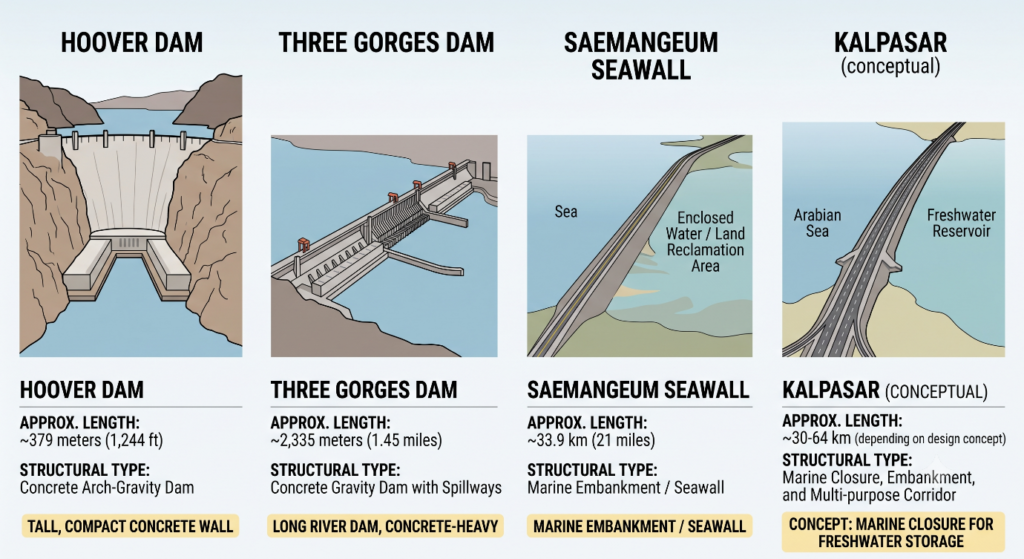
Kalpasar is not Hoover Dam stretched sideways. It is closer to a giant coastal closure—more seawall than canyon wall.
The concrete number sounds huge—but it is not the whole story
Our indicative back-of-the-envelope estimate places Kalpasar’s concrete requirement somewhere around 4–17 million cubic metres, with roughly 9 million cubic metres as a working midpoint. This is an author estimate, not an official project quantity.
At six cubic metres per mixer truck, that works out to about 1.5 million truckloads. Even then, most of the barrier would still consist of sand and stone.
Estimate note: The range assumes a predominantly sand-and-rock marine embankment, separate concrete-intensive hydraulic structures, broad preliminary-design allowances, and approximately 6 m³ per mixer truck.
Physics helps—but only up to a point
The structure receives one useful favour from physics. Unlike a conventional inland dam, Kalpasar would normally have water on both sides.
The barrier does not resist the full depth of the Arabian Sea every day; it mainly resists the difference in water level between the sea and the reservoir. That reduces the normal structural burden, although storm surges, waves, seepage, and extreme level differences would still dictate the worst-case design.
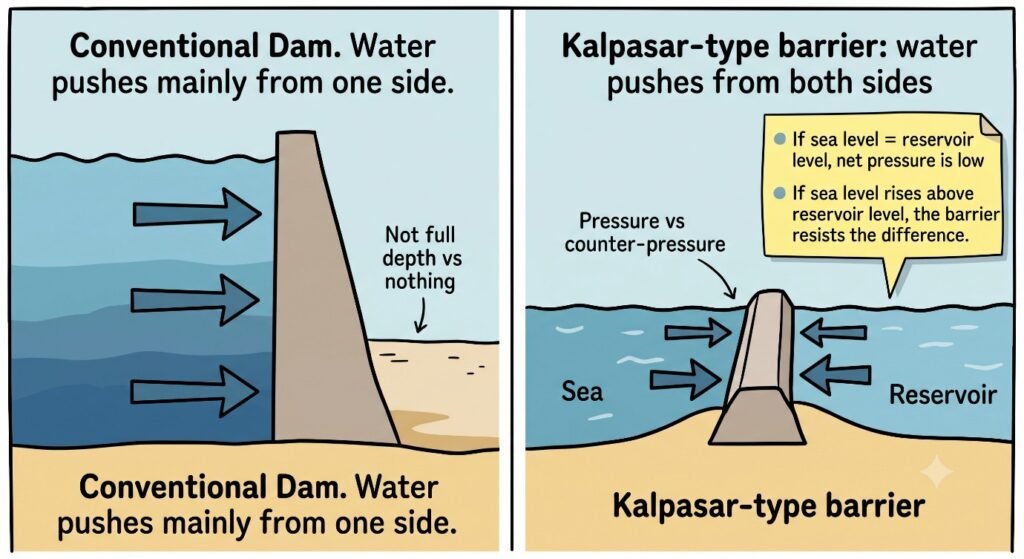
Kalpasar would not spend every day heroically holding back the Arabian Sea. With water on both sides, the real design challenge is the difference in water level—not the total depth alone.
The hidden cost is electricity
Then comes the hidden invoice: power.
Kalpasar may capture water near sea level, but farms and cities do not politely relocate downhill. Earlier project studies contemplated booster pumping to serve areas around the 50-metre contour and then higher regions approaching 100 metres.
Water flows downhill free of charge. To send billions of cubic metres uphill, Gujarat must pay in electricity—year after year.
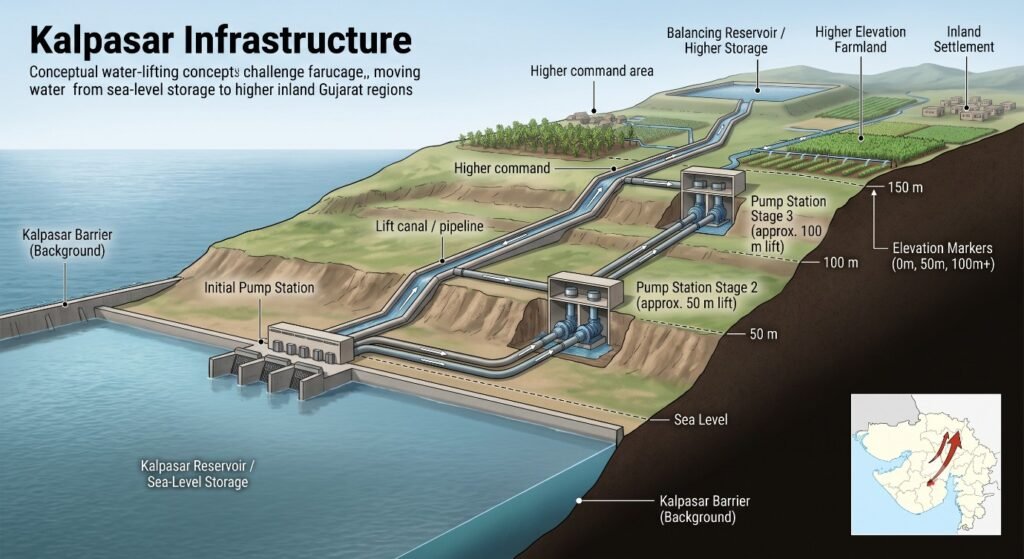
Kalpasar could store water near sea level. But to serve farms and cities farther inland, that water may need to be pumped tens of metres upward—turning the reservoir into a long-term electricity consumer.
The takeaway
The first megaproject is the barrier. It is spectacular, visible, and easy to imagine: a line across the Gulf of Khambhat.
The second megaproject is less photogenic but just as important: the power system required to make the stored water useful.
In other words: Kalpasar is not just a question of how to close a gulf. It is also a question of how much energy Gujarat is willing to spend to move that water where it is needed.
Sources and assumptions
Sources: [1] Saemangeum Development Agency: official overview identifying the Saemangeum seawall as a 33.9-kilometre marine embankment. [2] Government of Gujarat, Kalpasar Project pre-feasibility material: sand-fill embankment concept and associated hydraulic structures. [3] Government of Gujarat, Kalpasar planning studies: booster pumping contemplated for areas around the 50-metre contour and higher regions approaching 100 metres. [4] Concrete quantity and mixer-truck equivalents are indicative author calculations intended to illustrate scale; they are not official project estimates.