How the developed world’s labour shortage could reshape industrial opportunities for India
Developed economies are likely to use both immigration and automation. But if expanding immigration becomes harder politically or socially, the economic value of labour-saving technology rises — and with it, the importance of the industrial ecosystems that design, build and support it.
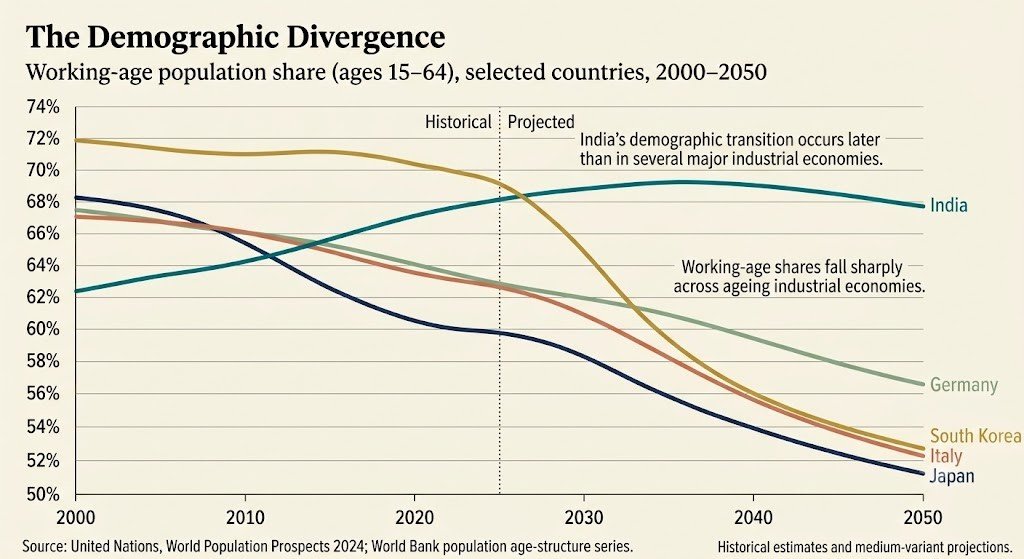
For much of the industrial era, labour was treated as an available input. Increasingly, parts of the developed world may have to treat it as a constraint. Using a 20–64 definition of working age, the OECD projects that the working-age population across its member countries could decline by about 8% by 2060, with much larger falls in some economies.[1] Ageing is therefore not only a social-policy question; it is becoming an industrial one. For cross-country comparison, Figure 1 uses the UN 15–64 age band; the two measures are complementary indicators of demographic direction rather than directly interchangeable values.
Economies have several responses to labour scarcity: raise workforce participation, extend working lives, move production abroad, accept lower output, attract migrants, or reduce labour dependence through technology. Immigration can expand the labour pool relatively quickly, but it is also constrained by housing, infrastructure, integration and domestic politics. Automation has different constraints — capital cost, implementation time and technical feasibility — but its attraction rises whenever labour becomes harder or more expensive to secure.
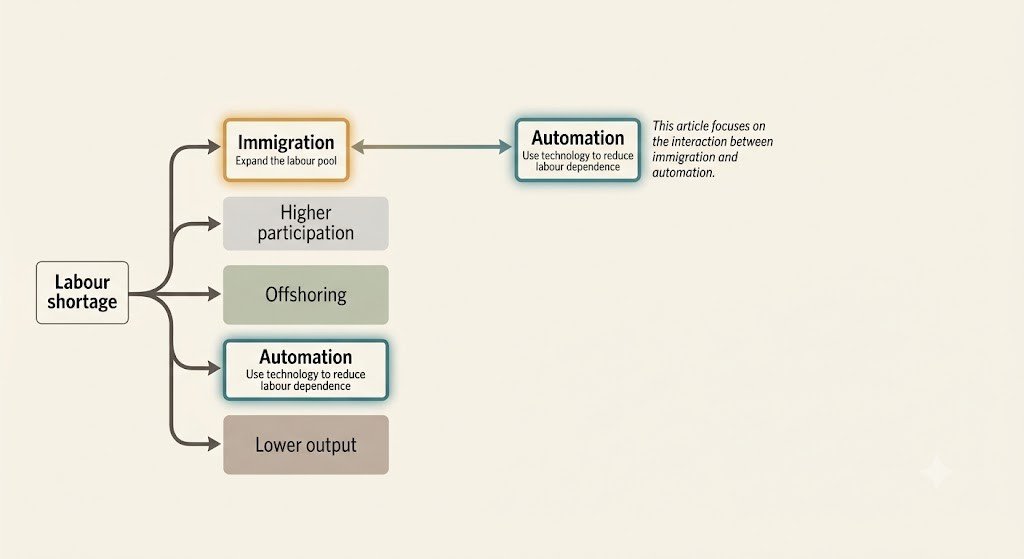
This does not mean immigration and automation are simple substitutes. Developed economies will almost certainly use both. The more interesting question is the relative difficulty of expanding each response. If adding workers through immigration becomes progressively harder, the value of making each worker more productive — or removing labour from selected tasks altogether — increases.
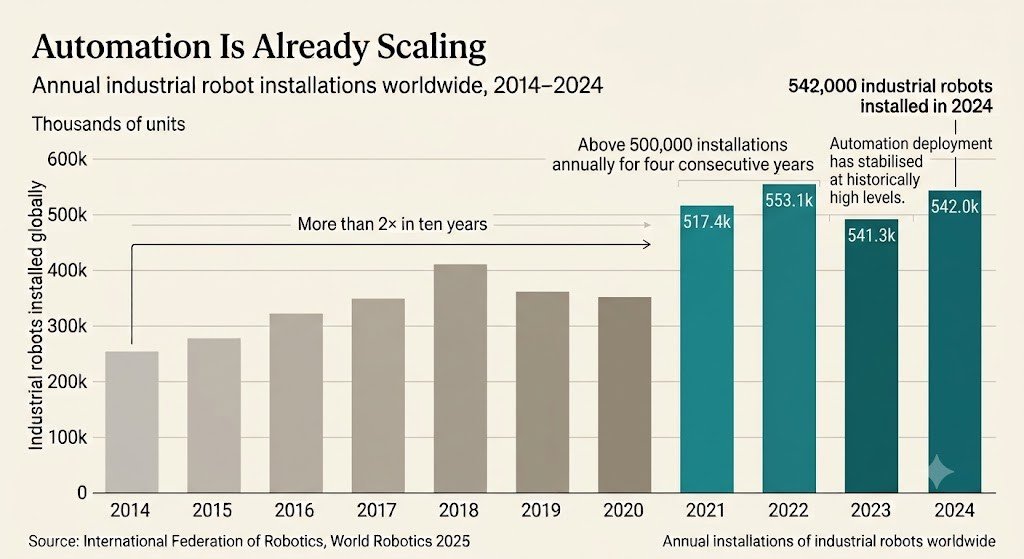
Automation is already being deployed at scale. The International Federation of Robotics reports that about 542,000 industrial robots were installed worldwide in 2024 — more than twice the annual number recorded ten years earlier. The 2024 total was the second-highest on record, about 2% below the 2022 peak, while annual installations remained above 500,000 units for a fourth consecutive year.[2] Robots are only one part of the automation stack: sensors, drives, machine vision, industrial software, AI, remote monitoring and system integration all become more valuable as factories search for ways to operate with fewer scarce workers.
This changes the industrial question for India. India remains much earlier in its demographic transition: UNFPA estimates that about 68% of its population was aged 15–64 in 2025, while the ILO continues to describe the country as positioned to benefit from a demographic dividend.[3][4] That advantage is not permanent. India is ageing too — just later.
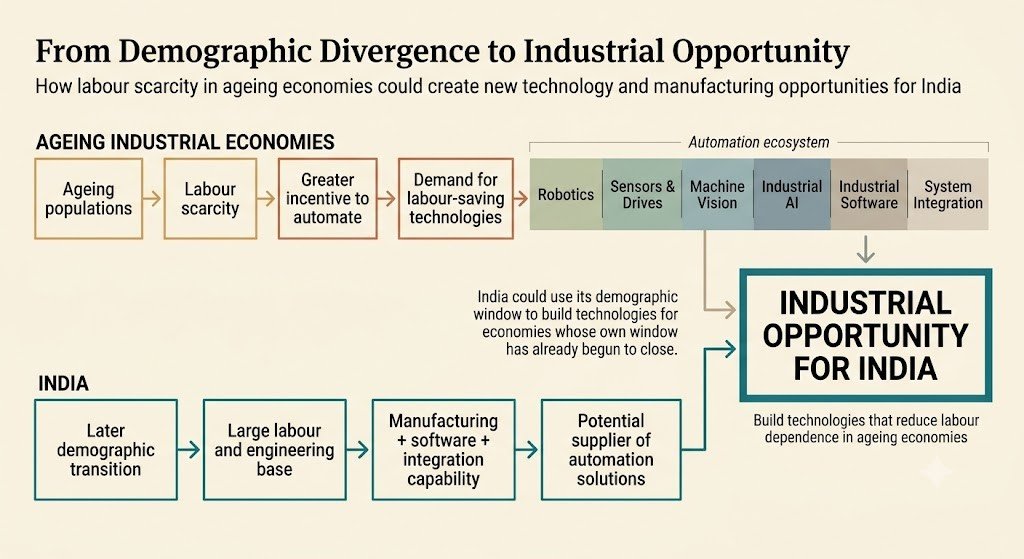
The unusual opportunity lies in the overlap. India may have a window in which it simultaneously possesses a large labour and engineering base and the chance to develop technologies for economies that increasingly need to conserve labour. Instead of viewing demographic advantage only as a source of migrant workers or low-cost manufacturing, India could use it to build capabilities in robotics, electronics, sensors, drives, machine vision, industrial AI, software and systems integration. Whether India can convert this window into globally competitive automation capability is a separate question — one involving engineering depth, capital, component ecosystems and competition from entrenched suppliers.
In that scenario, India’s labour abundance becomes the means by which it develops labour-substituting capability for markets where labour is becoming scarce. The immigration debate may therefore conceal a larger industrial opportunity: not simply supplying workers to ageing economies, but supplying the technologies that allow those economies to function with fewer workers.
Sources
- OECD Employment Outlook 2025 — working-age population (ages 20–64) projected to decline by about 8% across the OECD by 2060. Source
- International Federation of Robotics, World Robotics 2025 — about 542,000 industrial robots installed globally in 2024; second-highest annual total on record, about 2% below the 2022 peak; more than double the level ten years earlier. Source
- UNFPA, India Population 2025 — population aged 15–64. Source
- International Labour Organization, India Employment Report 2024 — India and the demographic dividend. Source