What happens when preparation, policy and opportunity begin to align
India’s recent defence-manufacturing surge offers a useful case study in industrial preparedness: not opportunity by itself, but capability, policy support, private participation and timing beginning to reinforce one another.
Industrial opportunities rarely arrive on schedule. More often, capabilities accumulate quietly until circumstances make them unusually valuable. India’s recent rise in defence manufacturing may be a particularly visible example.
The scale of change is striking. Official Ministry of Defence data show indigenous defence production rising from ₹43,746 crore in FY2013–14 to a record ₹1.78 lakh crore in FY2025–26. Defence exports moved even faster, from ₹686 crore to ₹38,424 crore over the same broad period, with Indian defence products reaching more than 80 countries. [1][2]
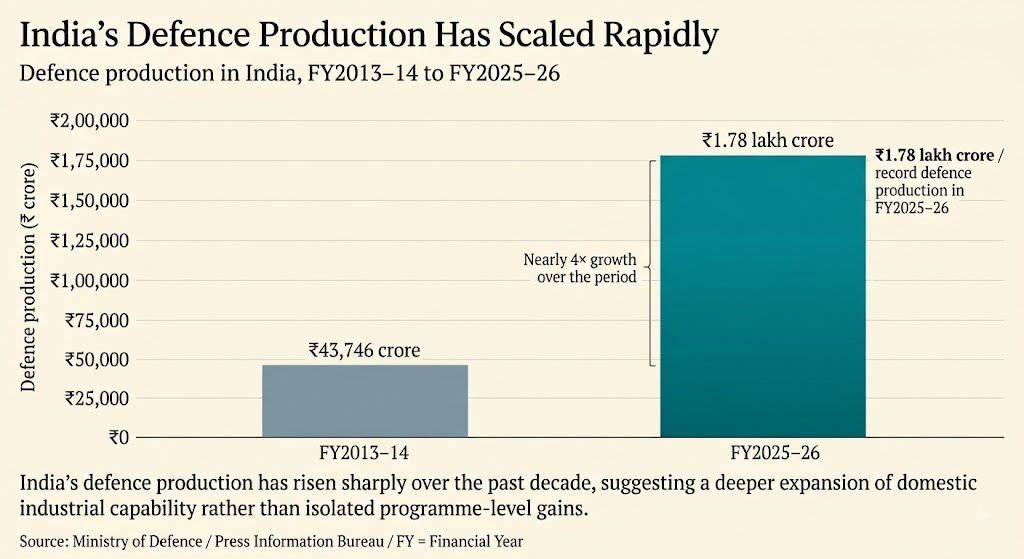
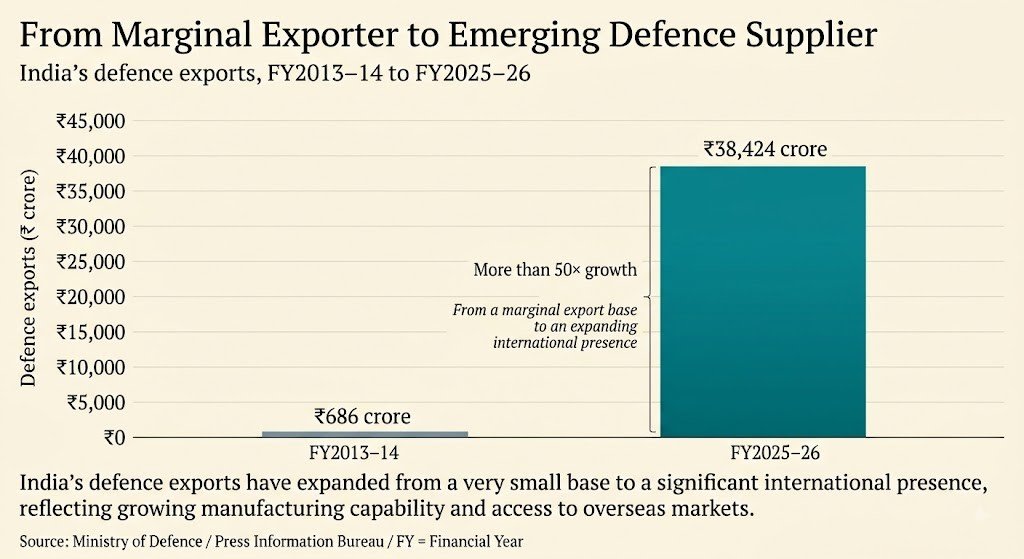
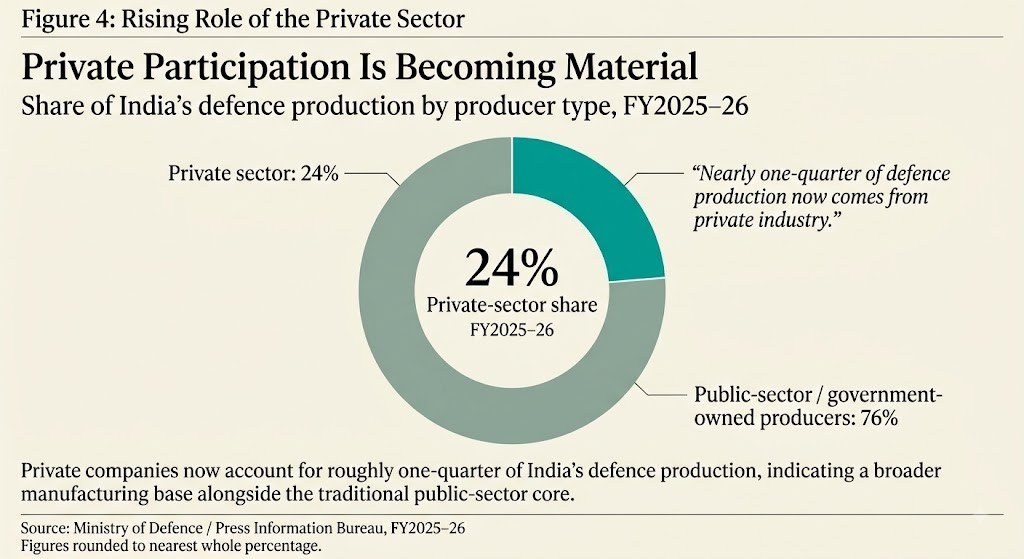
Government initiative appears to have provided an important enabling framework. Procurement reform, indigenisation measures, innovation programmes and preference for domestic sourcing progressively strengthened the demand signal for Indian manufacturers. At the same time, the production base broadened: private firms accounted for 24% of defence production in FY2025–26, their highest share yet, while public-sector producers remained the core of the system. [1]
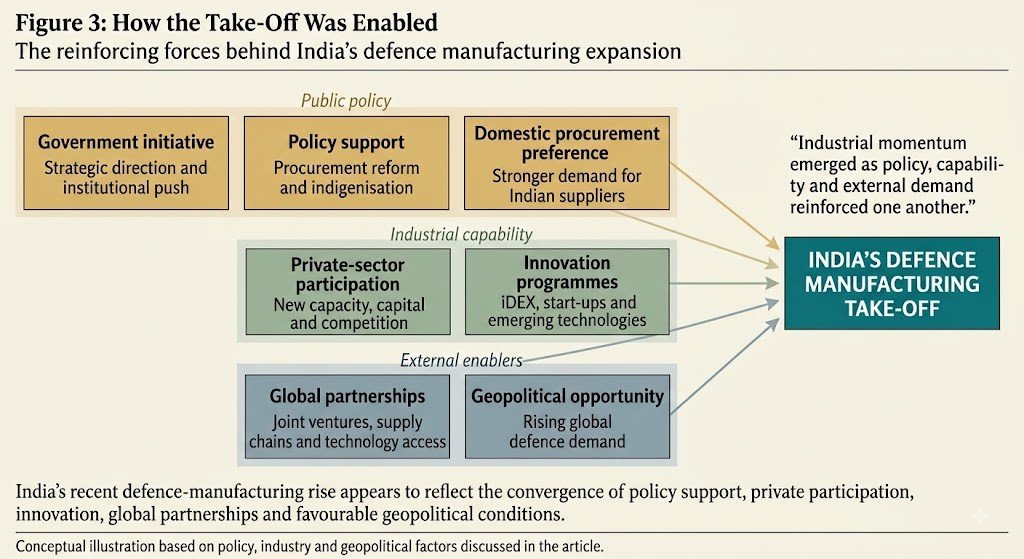
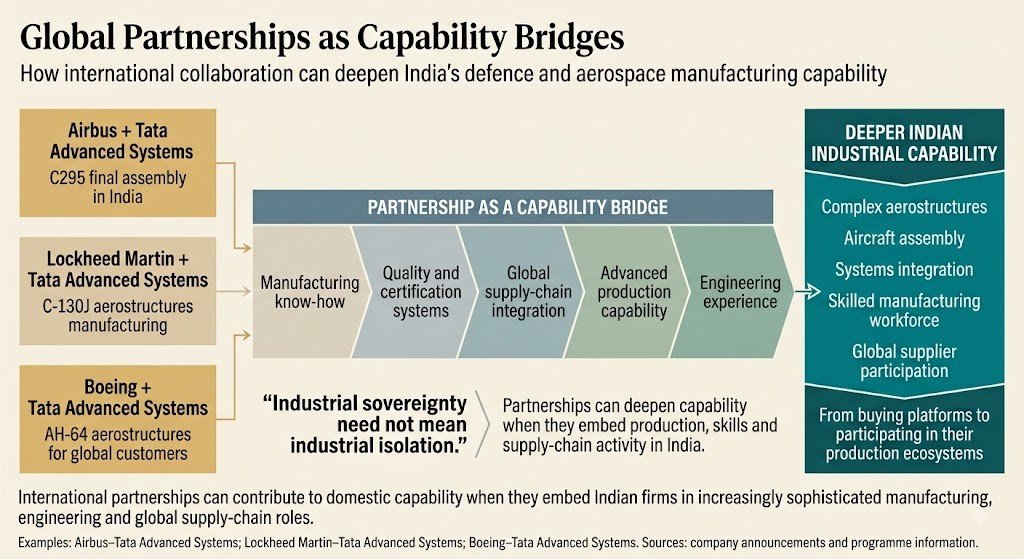
The expansion has also been outward-looking rather than isolationist. The Tata–Airbus C295 programme created a private-sector final assembly line in Vadodara; Tata and Lockheed Martin have built a long-running C-130J aerostructures relationship; and Tata Boeing Aerospace manufactures AH-64 aerostructures in Hyderabad for global customers. These arrangements suggest that international partnerships can become bridges into manufacturing know-how, quality systems, supply chains and more complex production roles. [3][4][5]
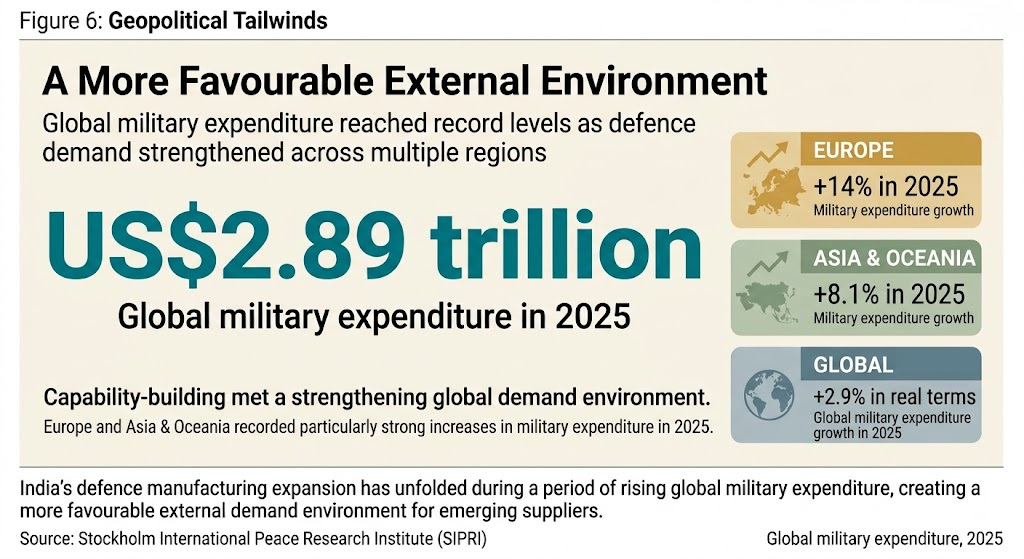
Timing has helped. Global military expenditure reached US$2.887 trillion in 2025, according to SIPRI, with particularly strong increases in Europe and Asia & Oceania. That does not mean geopolitics caused India’s industrial rise. It does mean that capability-building increasingly encountered a more supportive external demand environment. [6]
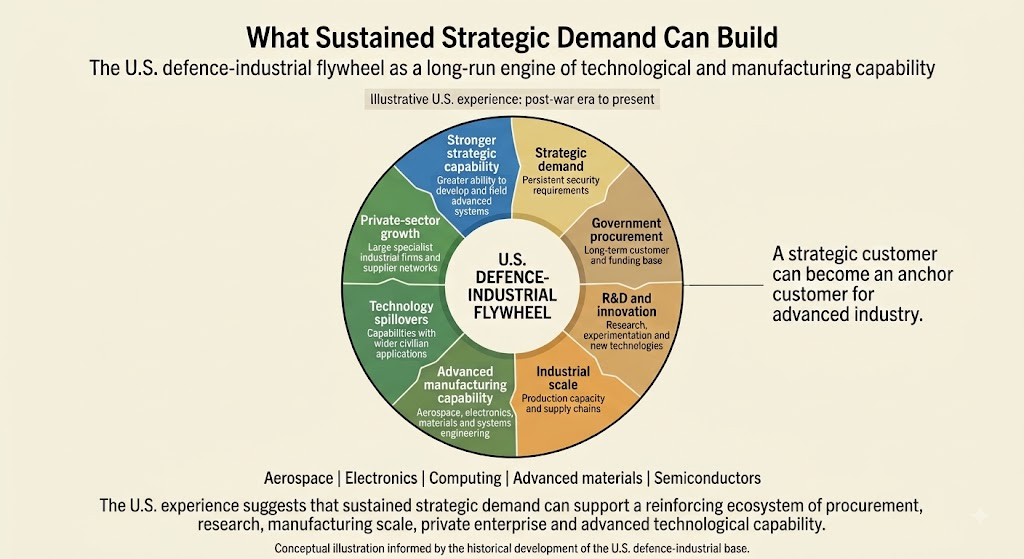
There is a useful historical parallel in the United States. Across the post-war decades, sustained strategic demand helped support a large ecosystem linking government procurement, research, specialist suppliers, advanced manufacturing and private enterprise. The contemporary U.S. Department of Defense still treats the health, breadth and innovation capacity of the defence industrial base as a strategic concern. [7] The comparison is illustrative rather than predictive: India’s institutional and market context differs in important ways, and its trajectory need not reproduce the American model.
India’s path is different, and its defence-industrial journey is far from complete. But one feature of the recent story is worth noting: much of the capability-building appears to have been underway before the external opportunity became fully favourable. That makes the sequence itself interesting. Preparation did not follow the opportunity; to some extent, it was waiting for it.
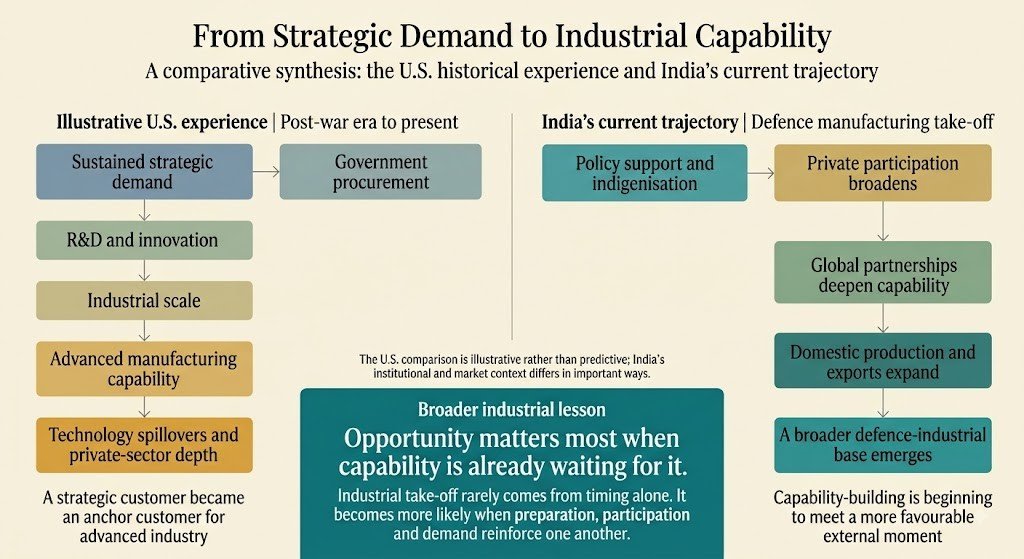
India’s defence manufacturing take-off is therefore worth watching not merely as a defence success story, but as an example of policy support, private participation, accumulated industrial capability and global collaboration converging at a favourable moment. The broader question is whether similar industrial preparation can be built elsewhere before the next opportunity becomes obvious to everyone.
Sources
[1] Ministry of Defence / Press Information Bureau, “Defence production soars to a record Rs 1.78 lakh crore in Financial Year 2025-26,” 17 June 2026. Link
[2] Ministry of Defence / Press Information Bureau, “Defence exports skyrocket to record Rs 38,424 crore in Financial Year 2025-26,” 2 April 2026. Link
[3] Airbus, “Tata Advanced Systems and Airbus inaugurate C295 Final Assembly Line in Vadodara, India,” 28 October 2024. Link
[4] Lockheed Martin, “Lockheed Martin and Tata Advanced Systems Announce Agreement to Expand C-130J Super Hercules Opportunities in India,” 10 September 2024. Link
[5] Boeing India, “Tata Boeing Aerospace Delivers 300 AH-64 Apache Fuselages,” 2025. Link
[6] Stockholm International Peace Research Institute, “Trends in World Military Expenditure, 2025,” 2026. Link
[7] U.S. Department of Defense, “Why America Needs the Defense Industrial Base,” remarks by Deputy Secretary Kathleen Hicks, 20 March 2024. Link
Editorial note: Figures 3, 5, 7 and 8 are conceptual synthesis illustrations. Quantitative figures use the official or institutional sources identified within each graphic.