By Team MEG
India’s renewable-energy build-out is increasingly becoming a grid, equipment and systems story. As solar and wind capacity rises, the next phase of the transition will depend as much on transmission, balancing, storage and power electronics as it does on adding generation.
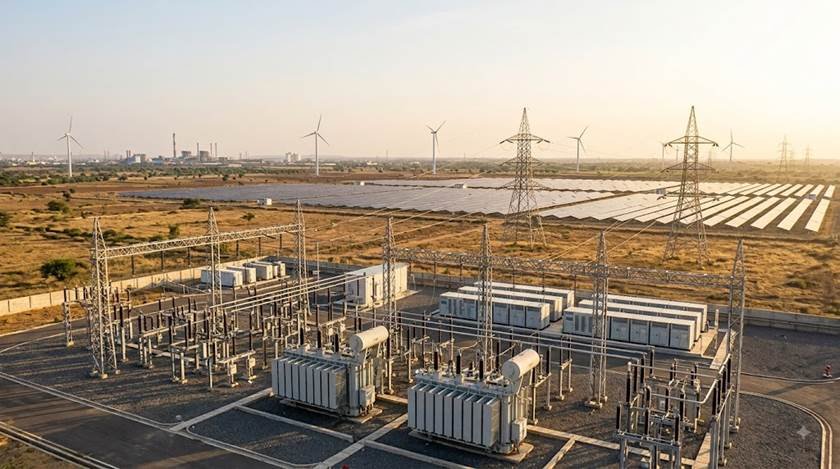
A modern power system is increasingly an ecosystem: renewable generation, transmission, substations, transformers and storage must expand together.
The Signal
India added almost 11.9 GW of solar capacity in the first three months of FY2026-27, taking cumulative solar capacity to approximately 162.2 GW by the end of June 2026. Wind capacity stood at about 57.4 GW, after adding another 1.35 GW during the same three-month period.
Those numbers tell an impressive generation story. But they also point towards a less visible industrial challenge.
A power system containing ever-larger quantities of solar and wind is fundamentally different from one dominated by dispatchable coal, gas, hydro and nuclear generation. Solar output follows daylight and weather conditions. Wind generation fluctuates with wind availability. Electricity demand, however, follows neither.
The engineering problem therefore increasingly shifts from simply producing more electricity to ensuring that electricity can be transported, balanced and delivered when and where it is needed. India’s renewable build-out is consequently creating a second infrastructure cycle behind the first.
The Numbers
India’s overall power system has already grown considerably. Installed electricity-generation capacity crossed 520 GW by early 2026, while the country’s transmission network exceeded 500,000 circuit kilometres.
Under the National Electricity Plan, India’s transmission network is expected to increase from approximately 504,000 circuit km in February 2026 to around 648,000 circuit km by 2032. Transformation capacity is planned to rise from roughly 1,429 GVA to 2,345 GVA over the same period. Inter-regional transmission capability is expected to expand from approximately 120 GW in February 2026 to 143 GW by 2027 and 168 GW by 2032.
These are not secondary investments accompanying renewable energy. Increasingly, they are part of what makes additional renewable capacity usable.
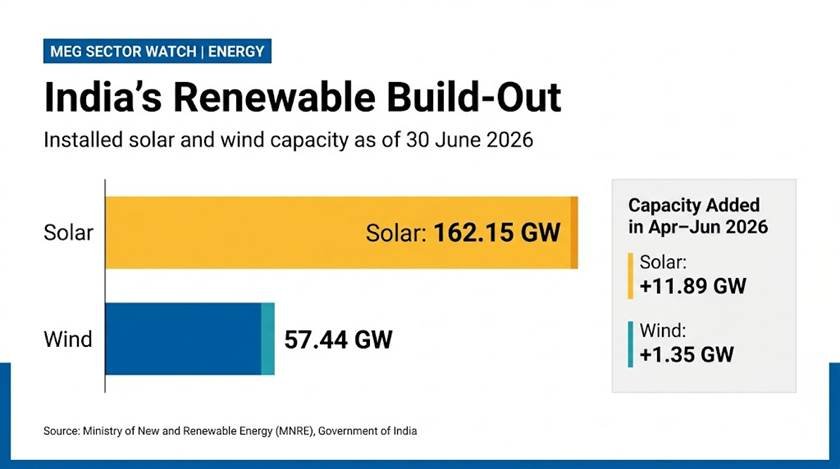
Installed solar and wind capacity as of 30 June 2026, with capacity additions during April-June 2026. Source: MNRE, Government of India.
Why It Matters
The traditional electricity system was comparatively straightforward conceptually: large generating stations produced electricity, transmission networks carried it over long distances, and distribution systems delivered it to consumers. Renewables introduce additional layers.
Large solar and wind resources are often located far from major demand centres. New generation therefore needs evacuation infrastructure. Variable output requires stronger balancing capability. Sudden changes in generation increase the value of forecasting and responsive grid control. Periods of excess generation create opportunities – and requirements – for storage. Increasing numbers of inverter-connected resources also change how system stability must be managed.
This broadens the industrial opportunity well beyond solar modules and wind turbines. Transmission towers and conductors are required to move power. Transformers and high-voltage switchgear are required to manage expanding networks. Battery energy-storage systems and pumped storage can shift electricity between periods of surplus and shortage. Power electronics, inverters and reactive-power equipment become increasingly important as inverter-based generation expands. SCADA, forecasting platforms, grid automation and energy-management systems become more valuable as operators manage a power system containing millions of increasingly dynamic assets.
The renewable-energy transition therefore has an important industrial multiplier: every gigawatt of generation can create demand elsewhere in the electrical-equipment and grid-technology value chain.
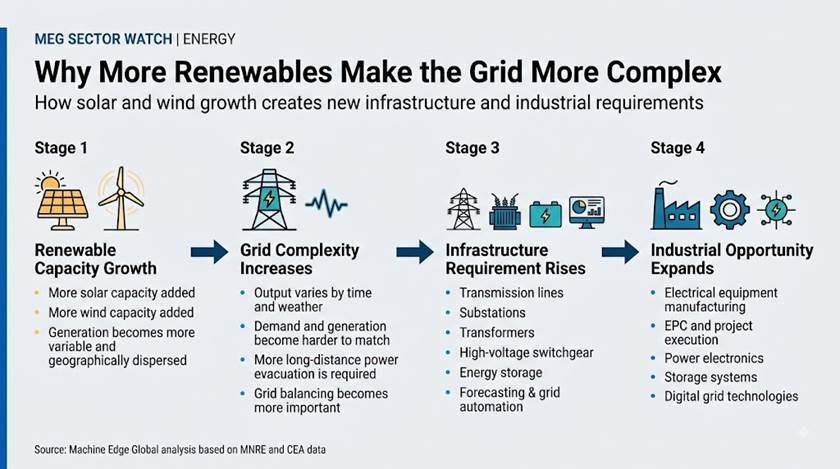
The industrial chain behind renewable growth: greater variability increases grid complexity, which raises requirements for transmission, storage, electrical equipment and digital grid technologies. Source: Machine Edge Global analysis based on MNRE and CEA data.
The India Angle
For Indian manufacturing, that distinction matters. The opportunity is not simply to manufacture more generating equipment. It is to participate in the infrastructure required to integrate the capacity being built.
India’s planned transmission expansion alone implies sustained requirements across transformers, cables, conductors, substations, switchgear, insulators, control equipment, engineering services and project execution. At the same time, renewable integration increases the importance of technologies that historically occupied smaller roles in the electricity system: grid-scale storage, advanced power electronics, digital substations, demand-response systems and increasingly sophisticated forecasting and dispatch tools.
This may also create new bottlenecks. Generation projects can be added relatively quickly, particularly solar. Transmission corridors, major substations and interstate infrastructure can involve land acquisition, right-of-way issues, approvals, equipment lead times and considerably longer development cycles.
| The relevant question is no longer only how fast India can add renewable capacity. It is whether the infrastructure around that capacity can expand at the same speed. |
That is where the next phase of India’s energy transition becomes an industrial story.
What MEG Is Watching
| 1 Transmission awards Pace of project awards and commissioning | 2 Equipment capacity Transformer and high-voltage equipment lead times | 3 Grid-scale storage BESS and pumped-storage commissioning | 4 System constraints Renewable evacuation and curtailment signals |
India’s renewable build-out is already large. The next test is whether the grid – and the industrial ecosystem behind it – can become equally ambitious.
Sources
• Press Information Bureau / Ministry of Power – India installed power capacity update
Editorial note: Figures are rounded in the article body for readability; the chart retains the supplied MNRE values to two decimal places.