By: Team MEG
India can add factories, assembly lines and final-product capacity rapidly, but advanced manufacturing increasingly depends on whether the domestic materials ecosystem can supply the alloys, chemicals, coatings, ceramics, composites and engineered materials that determine what those factories are actually capable of producing.
MEG THESIS
“Industrial capability ultimately encounters a materials ceiling: a country cannot manufacture products whose required material properties, purity, consistency or processability its materials ecosystem cannot reliably deliver.”
EVERY MANUFACTURING AMBITION EVENTUALLY REACHES THE MATERIAL
The factory is visible. The material capability that determines what the factory can produce often is not.
Industrial localisation is usually measured through visible assets: a semiconductor fab, a battery plant, an aircraft line, a turbine shop or an EV-motor facility. Yet each of these systems depends on a less visible question: can the material meet the requirement every time? Semiconductor-grade gases and chemicals, battery cathode and electrolyte materials, electrical steels, permanent magnets, nickel superalloys, titanium, carbon fibre, technical ceramics and specialty coatings can all become capability constraints several tiers below the finished product.
That changes how advanced materials should be understood. They are not merely procurement inputs. Their purity, internal structure, thermal behaviour, magnetic performance, conductivity, surface chemistry and processability increasingly define the performance envelope of the product itself. A useful industrial equation is therefore simple: Product Capability = Design × Manufacturing Process × Material Capability. A weakness in any one layer constrains the final result.
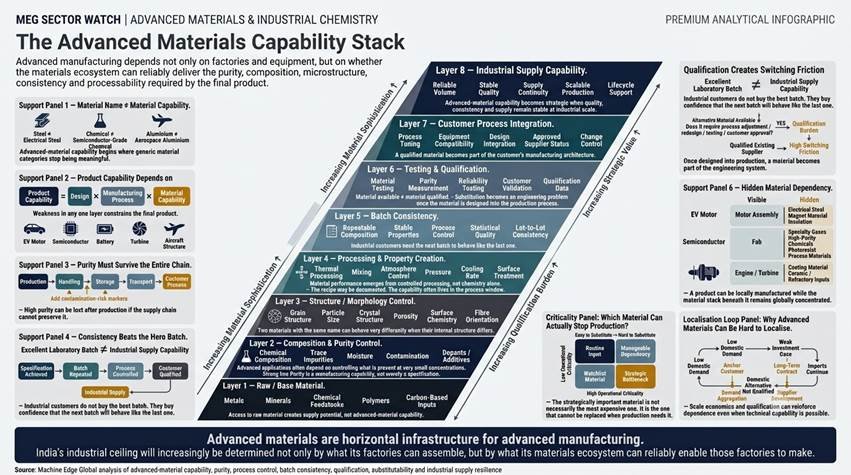
Visual 1. The Advanced Materials Capability Stack: advanced-material capability rises from raw inputs through purity, morphology, process control, consistency, qualification and customer integration to reliable industrial supply.
GENERIC MATERIAL CATEGORIES STOP BEING USEFUL
Advanced-material capability begins where generic material categories stop being meaningful.
“Steel”, “aluminium”, “silicon”, “graphite”, “ceramic” or “polymer” says little about whether a material can serve an advanced application. The decisive variables may instead be grade, purity, composition, grain structure, defect density, particle morphology, surface condition or dielectric behaviour. The industrial distinction is therefore not between having and not having a material; it is between producing a generic category and repeatedly delivering the very specific material state that a customer process requires.
This is why purity can become a manufacturing capability in its own right. In contamination-sensitive industries, unwanted moisture, particles, metallic impurities or residues can destroy yield or reliability even when the underlying chemistry is correct. High purity must therefore survive production, handling, storage, packaging, transport and customer use. A producer that reaches the required purity inside the reactor but cannot preserve it through the supply chain has not yet created a usable industrial material.
CONSISTENCY IS THE DIVIDE BETWEEN LABORATORY SUCCESS AND INDUSTRIAL SUPPLY
Industrial customers do not buy the best batch. They buy confidence that the next batch will behave like the last one.
A laboratory can produce an exceptional batch. Industry must reproduce the same behaviour across thousands of lots and years of supply. The progression is demanding: material demonstrated, specification achieved, batch repeated, process controlled, customer qualified and finally supplied at industrial scale. Statistical control and lot-to-lot consistency therefore matter as much as peak laboratory performance.
Much of that capability sits in process knowledge rather than chemistry alone. Mixing sequence, atmosphere, temperature, pressure, cooling rate, contamination control, surface preparation and equipment condition can all influence the finished material. The formula may be documented, but the stable process window is often accumulated through operating experience. Two plants using nominally identical recipes can therefore produce materials with different industrial performance.
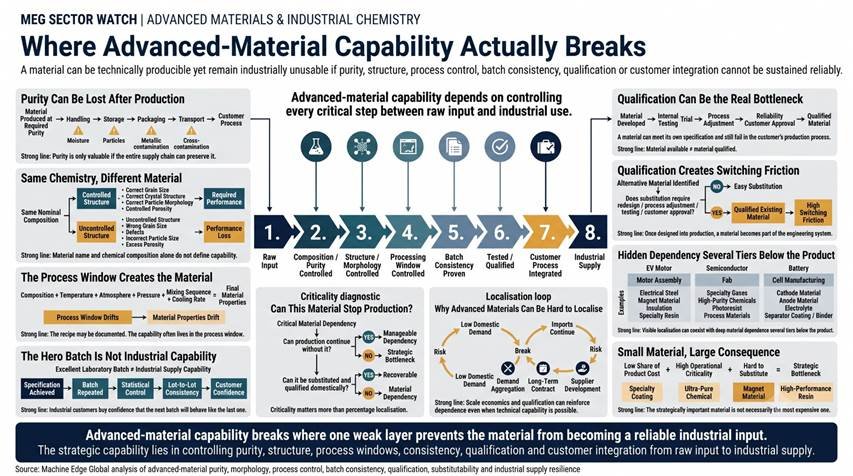
Visual 2. Where Advanced-Material Capability Actually Breaks: purity, morphology, process windows, consistency, qualification and customer integration can each prevent a technically producible material from becoming a trusted industrial input.
QUALIFICATION TURNS MATERIAL SUBSTITUTION INTO AN ENGINEERING PROBLEM
Material available ≠ material qualified.
Advanced materials are frequently designed into the customer’s production process. Changing one may require engineering trials, process retuning, reliability testing, redesign, yield analysis and customer approval. A domestic alternative can therefore exist chemically and still remain industrially unusable until the downstream process has been proven around it.
That creates switching friction. Once a material is qualified, it becomes part of the manufacturing architecture rather than a simple item on a purchasing list. The incumbent supplier gains value not only from the material itself but from the evidence accumulated around its use: repeatability, compatibility, reliability and change-control history.
THE MOST DANGEROUS MATERIAL MAY BE SMALL BY VALUE
The strategically important material is not necessarily the most expensive one. It is the one that cannot be replaced when production needs it.
A locally assembled EV motor may still depend on electrical steel, permanent magnets, insulation and specialty resin. A semiconductor fab may depend on specialty gases, high-purity chemicals and photoresists. A turbine may rely on superalloys, refractory inputs or specialised coating materials. These inputs can represent a small fraction of finished-product value while carrying very high operational criticality.
The more useful lens is criticality × substitutability. Routine inputs are easy to replace. Manageable dependencies may be important but have proven alternatives. Watchlist materials are difficult to substitute even if operational impact is limited. Strategic bottlenecks combine high consequence with poor substitutability. That framework is more useful than import share alone because it asks which material can actually stop the production system.
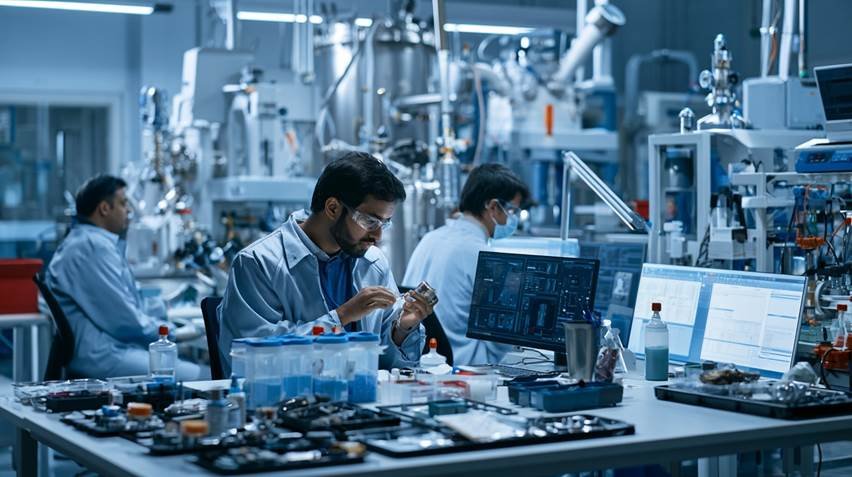
Visual 3. Advanced materials in practice: purity control, process-window discipline, material characterisation, batch repeatability and qualification turn engineered materials into reliable industrial supply.
LOCALISATION IS AS MUCH AN ECONOMIC AND QUALIFICATION PROBLEM AS A TECHNICAL ONE
Not every advanced-material dependency exists because domestic industry lacks scientific competence. Specialised plants may require expensive equipment, long qualification cycles, proprietary process knowledge and customer volumes that are initially too small to support investment. This creates a reinforcing loop: low domestic demand weakens the investment case, imports continue, domestic alternatives remain unqualified and customers therefore continue to import.
Breaking that loop may require anchor customers, demand aggregation, long-term contracts and deliberate supplier-development programmes. The objective is not indiscriminate self-sufficiency. Global sourcing remains rational where supply is diversified and substitutes are readily qualified. The strategic concern begins where concentration, qualification burden and low substitutability create a single point of industrial failure.
ADVANCED MATERIALS ARE HORIZONTAL INFRASTRUCTURE
A relatively small materials ecosystem can exert disproportionate influence over the manufacturing economy.
Materials capability cuts horizontally across sectors. Semiconductor chemicals, battery materials, rare-earth magnets, high-temperature alloys, composites, ceramics, thermal-management materials and specialty polymers can simultaneously strengthen electronics, EVs, batteries, aerospace, defence, energy equipment, medical devices and industrial machinery.
Recycling and recovery can also become strategic where they return constrained materials such as nickel, cobalt, lithium, rare earths or titanium into high-value production. But circularity only becomes an industrial capability when recovered material meets the purity, consistency and qualification standards required by demanding applications.
WHAT MEG IS WATCHING
| INDICATOR | WHY IT MATTERS |
| Purity & contamination | Semiconductor-grade chemicals, specialty gases, high-purity metals and the logistics needed to preserve specification. |
| Functional materials | Electrical steels, rare-earth magnets, thermal-management materials, high-performance polymers and specialty coatings. |
| Battery materials | Cathode, anode, electrolyte, separator, binder and precursor capability moving from pilot supply into qualified production. |
| High-performance structural materials | Titanium, nickel superalloys, specialty aluminium, carbon fibre, composites and technical ceramics. |
| Qualification depth | Customer trials, reliability validation, approval timelines, approved-supplier status and requalification capability. |
| Process capability | Morphology control, particle engineering, surface chemistry, thermal processing and stable production windows. |
| Supply resilience | Supplier concentration, substitutability, domestic alternatives, inventory criticality and lifecycle continuity. |
THE MATERIALS CEILING IS BECOMING THE INDUSTRIAL CEILING
The next stage of manufacturing competition will not be decided only by who builds more factories. As products become more demanding, those factories become dependent on increasingly specialised material ecosystems. The machine may be available, the product may be designed and the production line may be installed, but none of that overcomes a material whose required properties cannot be delivered reliably.
Advanced materials are becoming horizontal infrastructure for advanced manufacturing.
India’s industrial ceiling will increasingly be determined not only by what its factories can assemble, but by what its materials ecosystem can enable those factories to make. The strategic task is therefore to identify the materials whose purity, consistency, qualification burden or poor substitutability can constrain critical production — and then build the supplier, process and customer-integration depth required to remove those constraints.