India’s aerospace-manufacturing opportunity is entering a harder phase: moving beyond final assembly and structural work toward deeper domestic capability in propulsion, avionics, actuation, precision components, materials, software, tooling, qualification and lifecycle support.
MEG THESIS
“Aerospace localisation becomes strategically meaningful only when domestic capability moves beneath the final airframe into the critical systems, components, materials, process know-how and qualification infrastructure that keep the platform producible, upgradeable and supportable.”
THE AIRFRAME IS ONLY THE VISIBLE LAYER
Assembly can signal progress without revealing how deep the industrial capability actually goes
An aircraft rolling out of a domestic assembly line is visually powerful. It is also an incomplete measure of aerospace capability. The fuselage may be assembled locally while propulsion, avionics, actuation, sensors, specialised materials, software or test equipment remain externally controlled. In aerospace, a small number of such dependencies can still determine whether production continues, whether upgrades are possible and whether the platform can be sustained over decades.
The more useful question is therefore not simply whether the aircraft is built in India. It is which external dependency can still stop India from building, maintaining or modifying it. Aerospace assembly is visible; strategic control sits deeper in the supplier stack.
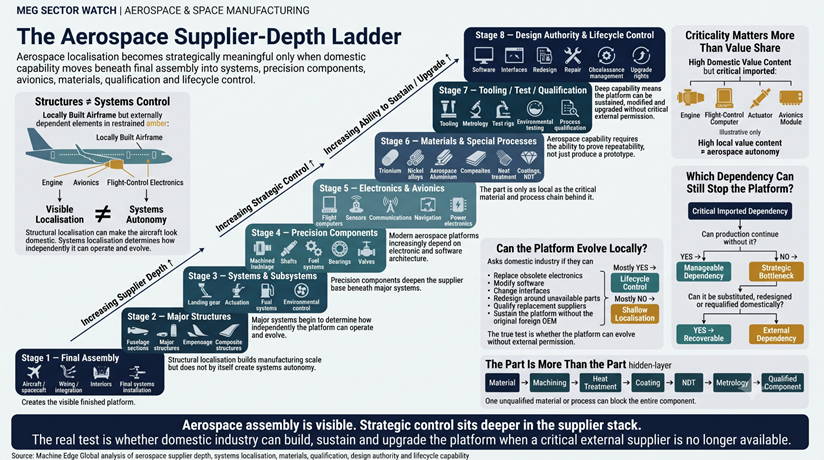
Visual 1. The Aerospace Supplier-Depth Ladder: strategic control deepens as capability moves below final assembly into systems, avionics, materials, qualification and lifecycle authority.
SUPPLIER DEPTH IS HARDER IN AEROSPACE
The industry is unusually unforgiving of shallow localisation
Aerospace components work under demanding combinations of load, vibration, temperature, fatigue, corrosion and weight constraints. Substitution is rarely as simple as finding a dimensionally similar part. A replacement may require engineering approval, process validation, testing, qualification, documentation and traceability before it can enter the platform. That makes supplier depth expensive and slow to build—but unusually valuable once established.
The supplier stack is also much deeper than the final airframe. Structures matter, but systems such as propulsion, flight controls, actuation, electronics and communications determine how independently a platform can operate and evolve. A programme may achieve substantial local content in structures and assemblies while remaining critically dependent on an imported engine, flight-control computer or actuator. The percentage of domestic value therefore matters less than the strategic criticality of what remains imported.
SYSTEMS, ELECTRONICS AND MATERIALS
Structural localisation can make the platform look domestic; systems localisation determines how independently it can evolve
Modern aerospace platforms are increasingly electromechanical and software-defined. Flight computers, sensors, navigation, communications, power electronics and embedded software sit alongside mechanical systems such as landing gear, fuel systems and actuation. That makes aerospace manufacturing inseparable from electronics capability and design authority: who controls the interfaces, source logic and upgrade path increasingly matters as much as who fabricates the airframe.
Materials and special processes create another hidden layer. Titanium, nickel alloys, aerospace aluminium, composites, coatings, heat treatment and non-destructive testing can determine whether a component is usable at all. A supplier may machine a part domestically yet still depend on an external material, coating or qualification process. The component is only as local as the critical material and process chain behind it.
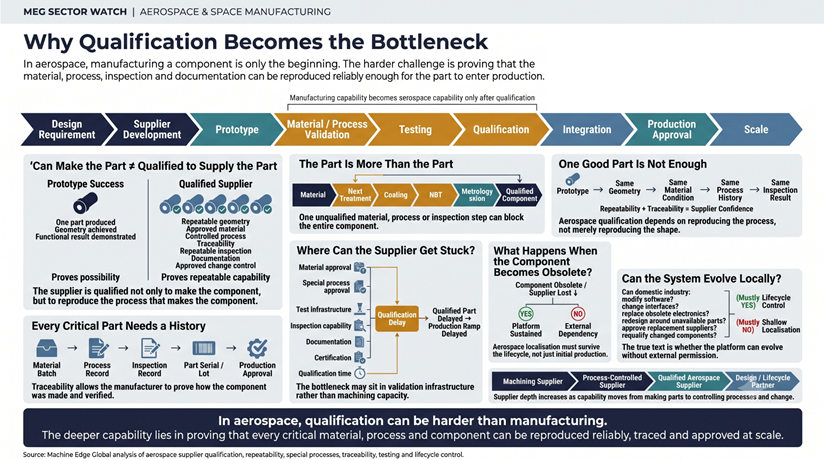
Visual 2. Why qualification becomes the bottleneck: aerospace suppliers must prove repeatable materials, processes, inspection, documentation and traceability—not merely produce one successful part.
QUALIFICATION IS A CAPABILITY OF ITS OWN
Making the component and being qualified to supply it are two different industrial achievements
The aerospace qualification chain can be longer than the manufacturing chain itself: design requirement, supplier development, prototype, material and process validation, testing, qualification, integration, production approval and scale. A technically successful prototype proves possibility. A qualified supplier must demonstrate repeatable geometry, approved material condition, controlled process history, reliable inspection and traceable documentation across production.
This is why the bottleneck may sit in test infrastructure, special-process approval, certification capacity or qualification time rather than machining capacity. The supplier is qualified not only to make the component, but to reproduce the process that makes the component. In aerospace, repeatability and traceability are part of the product.
LIFECYCLE CONTROL
The stronger test is whether the platform can still evolve when the original supplier or component disappears
Aircraft and spacecraft remain in service long enough for electronics to become obsolete, suppliers to disappear and material specifications to change. A shallowly localised platform can therefore be assembled domestically yet remain externally dependent throughout its life. Deeper capability means domestic industry can repair components, redesign around obsolescence, modify software, qualify replacement suppliers and revalidate changed systems without waiting for the original foreign technology owner.
That turns industrial sovereignty into a lifecycle concept. The real measure is not only whether the first platform can be produced, but whether the tenth-year upgrade and the twentieth-year sustainment problem can be solved locally.
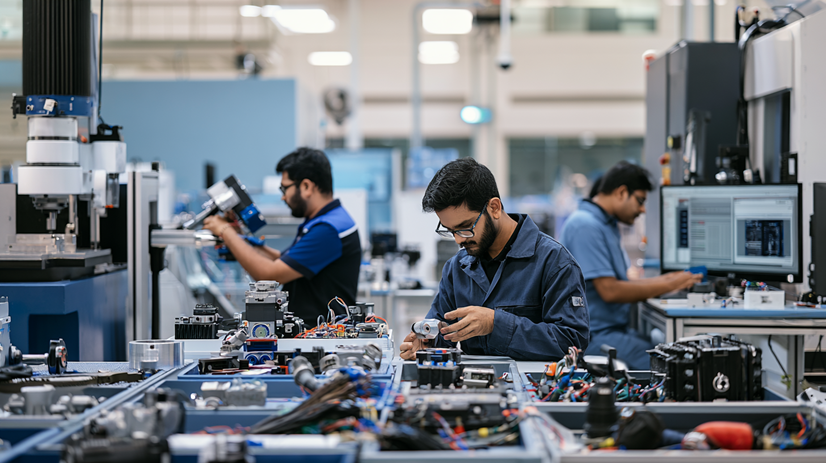
Visual 3. Aerospace supplier depth in practice: precision components, electronics, subsystem integration, machining, metrology and engineering review form the industrial base beneath final assembly.
THE INDUSTRIAL CONSEQUENCE
Aerospace can pull the wider manufacturing ecosystem up the capability curve
Aerospace volumes may be smaller than automotive or consumer manufacturing, but its supplier requirements can force capability gains in precision machining, composites, electronics, tooling, metrology, special processes, software and quality systems. Those capabilities can then spill into defence, energy, medical devices, automotive and industrial machinery. Aerospace therefore does more than consume advanced manufacturing capability; it can force the supplier base to develop it.
For India, the next phase of aerospace industrialisation will increasingly be judged below the airframe. Assembly and structures remain important, but deeper advantage lies in controlling the systems, materials, processes and qualification infrastructure that make the platform reproducible, supportable and upgradeable.
WHAT MEG IS WATCHING
Signals that India’s aerospace capability is moving from visible localisation to supplier depth
| Signal | What MEG is watching |
| Systems depth | Propulsion, actuation, landing gear, fuel systems and other critical subsystems moving into domestic design and supply. |
| Electronics & avionics | Flight computers, sensors, communications, navigation, power electronics and software interfaces. |
| Materials & special processes | Titanium, nickel alloys, composites, heat treatment, coatings, NDT and other qualified process capability. |
| Qualification infrastructure | Test rigs, environmental testing, metrology, process approval, traceability and supplier certification. |
| Lifecycle authority | Repair, redesign, software modification, obsolescence management and ability to qualify replacement suppliers. |
| Supplier repeatability | Evidence that domestic suppliers can reproduce controlled processes at scale, not only deliver successful prototypes. |
“Aerospace localisation becomes deeper when domestic capability moves from assembling the platform to controlling the supplier stack beneath it.”
The real test is not whether the aircraft is assembled in India. It is whether India can keep building, upgrading and sustaining it when a critical external supplier is no longer available.