As electric-vehicle volumes rise, the next measure of localisation will be how much of the battery, inverter, motor, thermal and control stack is manufactured and engineered domestically.
| MEG THESIS An EV assembled in India is not necessarily an EV powertrain built in India. The next phase of localisation is about owning the layers that make the vehicle move. |
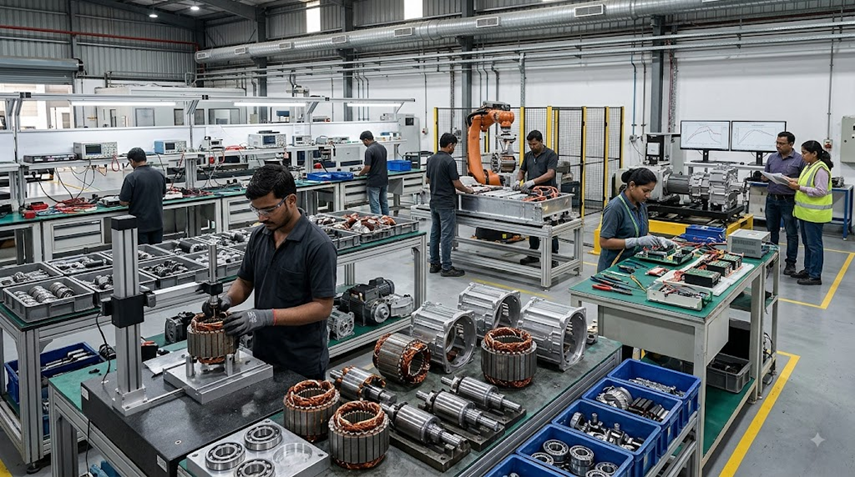
Hero visual: EV powertrain manufacturing depth — motors, electronics, integration and validation rather than final vehicle assembly.
The Signal
India’s electric-vehicle market has reached a scale at which localisation can no longer be judged only by the number of vehicles rolling off assembly lines. EV penetration reached about 8.5% of total vehicle registrations in FY2025–26, while electric passenger-vehicle registrations rose by more than 80% year on year. Adoption is therefore becoming large enough to support a deeper domestic supplier ecosystem.
That ecosystem is already broadening. An August 2026 Government of India review notes that domestic EV production now covers battery packs, motors, drivetrains, power electronics, wiring and charging equipment. The important shift is not simply that more EVs are being assembled in India, but that more of the systems beneath the body shell are beginning to be produced locally.
| The next localisation question is not “Where was the EV assembled?” It is “How much of the propulsion architecture is actually owned domestically?” |
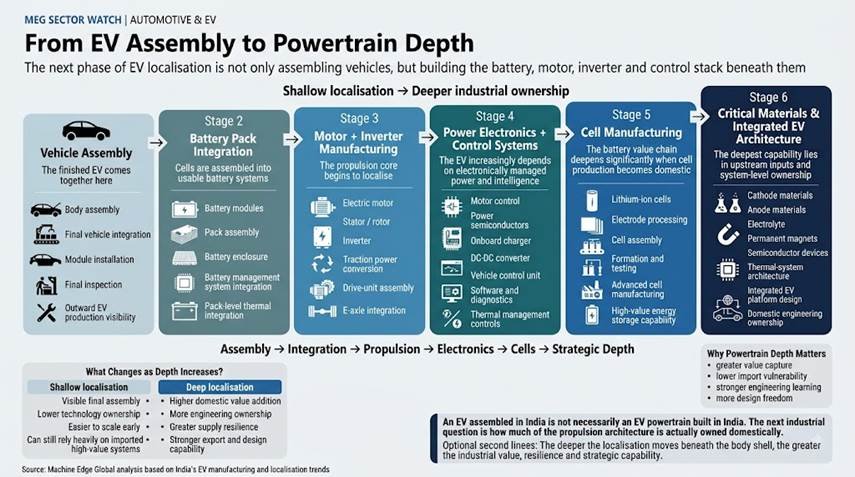
Visual 1 — From EV Assembly to Powertrain Depth: localisation becomes strategically deeper as ownership moves from final assembly toward propulsion, electronics, cells and upstream materials.
The Hidden Powertrain
An electric vehicle appears mechanically simpler than an internal-combustion vehicle, but the apparent simplicity hides a tightly integrated electro-mechanical system. Stored energy passes from the cell into the battery pack, through the battery-management system and inverter, into the electric motor, through a reduction gear and ultimately to the wheels. Thermal management, onboard charging, DC–DC conversion, software and diagnostics coordinate the system around that main energy path.
This matters industrially because each layer represents a different level of engineering ownership. A supplier that assembles a battery pack from imported cells has meaningful manufacturing capability, but it does not own the same technology depth as a company that manufactures the cells, designs the BMS, controls the thermal architecture and qualifies the complete system. The same logic applies to e-motors and inverters.
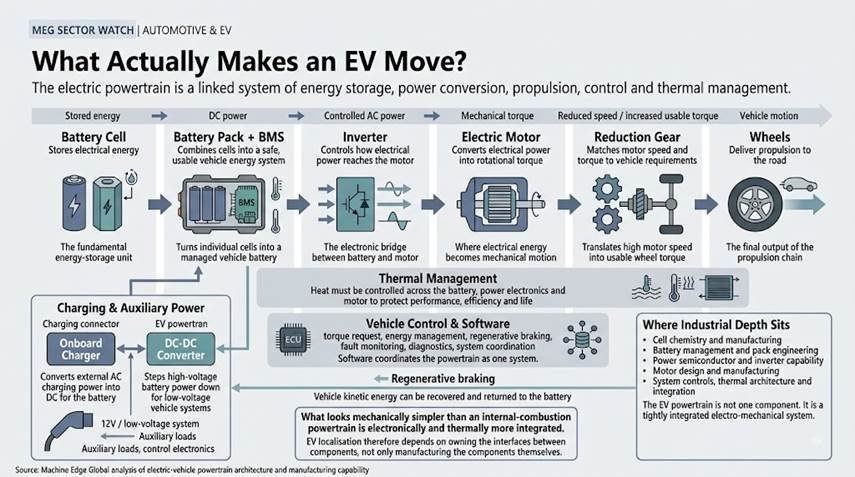
Visual 2 — What Actually Makes an EV Move? The propulsion chain is supported by software, charging, auxiliary power and thermal management across the system.
Why Assembly Can Mislead
Final vehicle assembly is highly visible. It creates jobs, supplier demand and industrial activity. But it can coexist with dependence on imported high-value technology. An EV may carry a locally fabricated body, locally assembled battery pack and locally integrated drivetrain while still relying on imported cells, power-semiconductor devices, permanent magnets, specialist electronics or manufacturing equipment.
That distinction is important because the value captured by a manufacturing ecosystem is not evenly distributed across the vehicle. Some of the most strategically important capabilities sit upstream or inside apparently small modules: cell chemistry, semiconductor switching, magnetic materials, embedded control, thermal design and system integration.
Where India Is Deepening
India is already building useful depth in several downstream and midstream layers. Battery-pack assembly, motors, drivetrains, power electronics, wiring and charging equipment are increasingly present in the domestic supplier base. Dedicated EV platforms, gigafactory investments and supplier localisation programmes are extending that depth further.
The industrial consequence is significant. Each additional layer retained locally creates more opportunities for process engineering, tooling, testing, traceability, supplier qualification and design iteration. It also allows domestic firms to move from build-to-print manufacturing toward functional ownership of the subsystem.
Where the Harder Gaps Remain
Battery cells illustrate the challenge. India’s Advanced Chemistry Cell programme targets 50 GWh of domestic manufacturing capacity. As of February 2026, 40 GWh had been awarded to four beneficiary firms, but only a small fraction of that awarded capacity had actually been installed. The Ministry of Heavy Industries also identified limited technology availability, skilled-manpower gaps, imported critical equipment and the non-availability of upstream materials such as cathode active material, anode active material and electrolyte as constraints.
These are not peripheral issues. They show that localisation becomes progressively harder as it moves upstream. A battery-pack line can scale faster than a competitive cell ecosystem. A motor can be assembled domestically while permanent-magnet dependence remains external. An inverter can be integrated locally while key semiconductor devices are imported. Deep localisation therefore requires capability across materials, equipment, process know-how and design—not just final assembly capacity.
Why Powertrain Depth Matters
| Industrial effect | Why it matters |
| Value capture | More of the vehicle’s high-value propulsion content remains inside the domestic industrial ecosystem. |
| Supply resilience | Local engineering and manufacturing reduce exposure to disruptions in imported subsystems and critical interfaces. |
| Engineering learning | Repeated design, testing and production create cumulative knowledge that simple assembly cannot replicate. |
| Design freedom | Greater ownership of the powertrain allows OEMs and suppliers to optimise cost, performance, thermal behaviour and packaging for local and export markets. |
The Supplier Model Is Also Changing
The transition to EVs changes the role of the automotive supplier. Mechanical manufacturing remains important, but propulsion performance increasingly depends on the interfaces between mechanical parts, electronics, software and thermal systems. The supplier that owns only one component may remain valuable; the supplier that can integrate several of those disciplines can become strategically harder to replace.
That is why the next generation of EV suppliers may look less like traditional component manufacturers and more like systems companies. Their competitive advantage will come from combining production capability with design authority, validation, embedded controls, functional safety, diagnostics and lifecycle support.
| The deeper the localisation moves beneath the body shell, the greater the industrial value, resilience and strategic capability. |
What MEG Is Watching
| Signal | What it will tell us |
| Cell manufacturing ramp | How quickly awarded cell capacity moves from announcements and pilot lines into commercially meaningful production. |
| Domestic value addition | Whether localisation rises in the high-value layers, not only in final assembly and pack integration. |
| Motor and inverter depth | Domestic ownership of e-motor design, power modules, inverter control, e-axle integration and validation. |
| Semiconductor sourcing | How Indian EV manufacturers manage dependence on power-semiconductor devices and automotive electronics. |
| Magnet dependence | Whether motor architectures, recycling, alternative materials or domestic supply reduce exposure to permanent-magnet constraints. |
| Thermal-system capability | Local design and validation of cooling architecture across cells, packs, inverters and motors. |
| Systems ownership | Whether suppliers progress from component manufacture toward integrated propulsion subsystems with design and lifecycle responsibility. |
The Industrial Test
India’s EV transition is increasingly visible on roads. The harder and more consequential transition is taking place inside factories, laboratories and supplier networks. The country can assemble large numbers of electric vehicles without necessarily owning the technologies that determine cost, reliability, performance and resilience.
The next phase of the EV manufacturing story will therefore be measured by depth: how far domestic capability moves from the body shell into the battery, inverter, motor, thermal system, software stack, cells and critical upstream inputs.
That is where the industrial value sits—and where the next competitive advantage will be built.
Sources & Editorial Note
• Press Information Bureau, Government of India, “The Rise of India’s Electric Vehicles Ecosystem,” 5 August 2026. Used for the domestic-manufacturing scope and 2025 EV-market context.
• Ministry of Heavy Industries, Rajya Sabha Unstarred Question No. 1683, answered 13 February 2026. Used for the 50 GWh ACC target, 40 GWh awarded capacity, installed-capacity status and identified upstream/technology constraints.
• Society of Indian Automobile Manufacturers (SIAM), FY2025–26 industry performance release, 14 April 2026. Used for the statement that electric passenger-vehicle registrations increased by more than 80% in FY2025–26.
• JMK Research, “India’s EV Penetration Reached 8.5% in FY2025–26,” 7 April 2026; also republished by SIAM. Used for overall EV penetration and registration growth context.
Editorial note: Machine Edge Global uses these public data points as signals for industrial analysis. The article’s discussion of localisation depth, supplier evolution and strategic capability is MEG analysis rather than a government or industry-body forecast.