India’s manufacturing ambitions increasingly depend not only on the factories being built, but on whether the machine tools, process equipment, precision systems and industrial machinery inside those factories can also be designed, manufactured and supported domestically.
| MEG THESIS |
| A country does not fully control its manufacturing capability if it remains dependent on imported machines to manufacture strategically important products. |
The factory is visible. The capability is not.
A new factory is easy to photograph: buildings, production lines, robots, employees and finished products moving through the gate. It creates an immediate impression of industrial capability. Yet a harder question sits behind the image: who built the machines inside the factory?
A plant may assemble sophisticated products domestically while relying on imported machining centres, presses, furnaces, grinders, precision drives, controllers, inspection systems and specialised tooling. That creates a critical distinction: installed factory capacity is not the same thing as manufacturing capability.
| “Buildings create production space. Machines determine what can actually be produced.” |
The real capability sits partly inside the equipment that determines tolerance, throughput, repeatability, process stability and the ability to sustain production over time. As India moves toward more complex manufacturing, capital goods increasingly deserve to be treated as strategic infrastructure rather than as a supporting industry.
THE ENABLING LAYER
Capital goods sit beneath the industrial economy
Capital goods are different from most manufacturing sectors because their output becomes the productive infrastructure of other sectors. A machine-tool company does not merely sell a machine. It enables another company to produce engine parts, transmission components, aerospace structures, defence housings, turbine equipment, rail systems, dies, moulds, medical devices and industrial machinery.
This creates a multiplier effect. A single high-capability machinery supplier can raise the productive capability of dozens or hundreds of downstream manufacturers. This is why machine tools are often described as “mother machines”: they produce the parts and equipment from which other industrial systems are built.
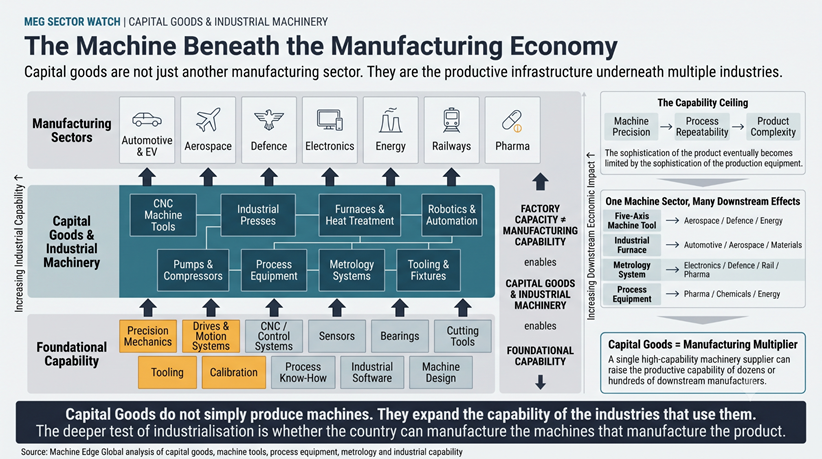
Visual 1. Capital goods form the enabling layer beneath multiple manufacturing sectors; their capability rests on deeper foundations in precision mechanics, controls, tooling, metrology and process know-how.
The implication is broader than machine tools. Industrial presses, furnaces, pumps, compressors, process equipment, robotics, metrology systems and tooling all act as horizontal capability layers. Their development strengthens several sectors simultaneously.
THE CAPABILITY CEILING
Every industry eventually runs into the capability ceiling of its machines
As manufacturing moves into more demanding products, the requirements placed on production equipment rise sharply. A basic component may require ordinary machining and moderate tolerances. A high-end aerospace, semiconductor, defence or energy component may demand micron-level accuracy, five-axis motion, stable thermal behaviour, high-speed spindles, automated tool management, closed-loop control and sophisticated measurement.
At that point, the bottleneck may no longer be labour, factory space or demand. It becomes machine capability. A manufacturer cannot reliably produce beyond the precision, repeatability and process control of the equipment available to it.
| “The sophistication of the product eventually becomes limited by the sophistication of the machine that produces it.” |
The hidden import dependence inside domestic manufacturing
Localisation measured at the final product can hide another dependency one layer down. A domestically manufactured machine may have a local structure, enclosure and final assembly while still depending on imported CNC controllers, servo drives, encoders, precision bearings, ball screws, spindles, sensors, software, cutting tools or measurement systems.
The machine can therefore be locally assembled without representing full technological control. The strategic question is not simply how much of the machine is domestic by value. It is whether one unavailable imported subsystem can still stop the downstream production process.
That makes criticality more useful than localisation percentage. A relatively low-cost control, bearing, encoder or spindle can be far more important than its value share suggests if there is no qualified substitute.
FROM ASSEMBLY TO CONTROL
From machine assembly to machine capability
Capital-goods indigenisation is better understood as a progression than as a binary local-versus-imported label. The deeper domestic capability moves through the machine’s technology stack, the greater the ability to maintain, modify, improve and redesign the equipment independently.
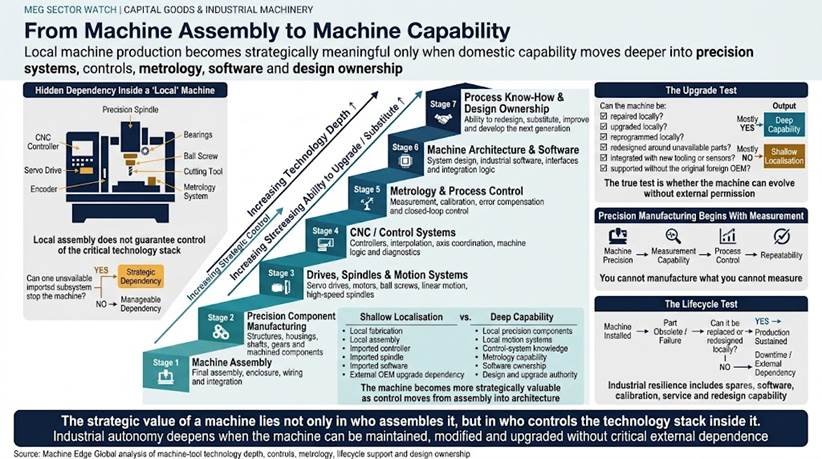
Visual 2. Machine capability deepens as control moves from final assembly into precision components, motion systems, CNC controls, metrology, software, architecture and design ownership.
At the shallowest level, a company can assemble a machine. At the deepest level, it can redesign the architecture, change interfaces, substitute unavailable components, modify software, improve process performance and develop the next generation without waiting for an external original-equipment manufacturer.
| “The true test is whether the machine can evolve without external permission.” |
CONTROLS, MEASUREMENT AND TOOLING
The control system is becoming a hidden strategic layer
Modern machine tools are increasingly electromechanical computing systems. The CNC controller coordinates axis movement, spindle speed, interpolation, process sequencing, safety, diagnostics, compensation and data collection. It determines how mechanical precision is converted into repeatable production.
Dependence on external control architectures can therefore affect performance, maintenance, software access, upgrades and integration. As factories become more connected and machines become more software-defined, control-system depth becomes a larger part of machine sovereignty.
Precision manufacturing begins with measurement
Metrology is the companion capability to precision production. A manufacturer cannot consistently hold a tolerance that it cannot measure accurately. Coordinate measuring machines, optical inspection, calibration, surface measurement, probes and process-monitoring systems therefore become part of the manufacturing stack rather than downstream quality accessories.
| “You cannot manufacture what you cannot measure.” |
The same logic applies to tooling. Cutting tools, fixtures, jigs, dies, moulds and workholding systems influence cycle time, surface finish, repeatability and process stability. A factory may own world-class machinery and still underperform if the surrounding tooling ecosystem is weak.
This yields another useful distinction: machine capacity is not the same thing as process capability. The productive system includes the machine, tooling, software, measurement, operator knowledge, maintenance and process engineering.
THE PHYSICAL CAPABILITY
The machine is only one part of the productive system
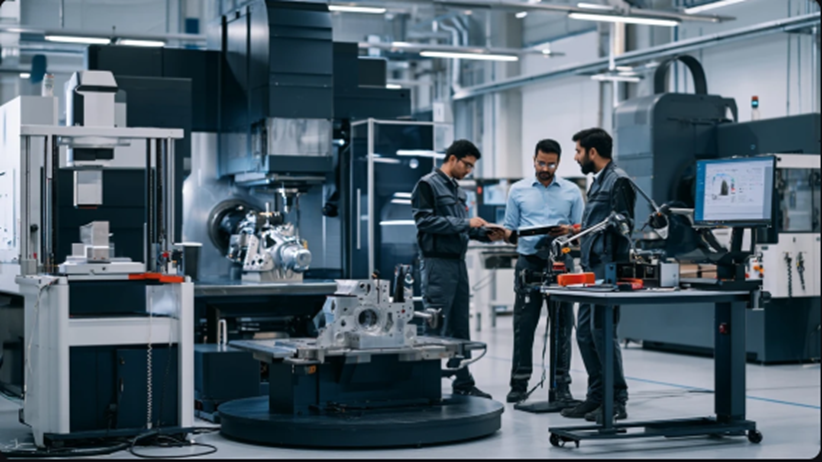
Visual 3. Advanced manufacturing capability emerges from the combination of high-precision machinery, complex workpieces, measurement systems and engineering knowledge.
A high-end machining centre becomes strategically meaningful only when the surrounding system can operate it effectively: engineers must understand the process, tooling must be available, dimensions must be verified, software must be configurable, and the equipment must be maintainable over its operating life.
Lifecycle support is part of industrial resilience
Industrial machinery is rarely a one-time purchase. Production depends on installation, calibration, spare parts, service, software support, retrofits, upgrades and process optimisation. A machine that cannot be repaired quickly or upgraded locally can become a production bottleneck even when the factory itself is entirely domestic.
The lifecycle test is straightforward: when a component becomes obsolete or fails, can the machine be restored or redesigned locally? If the answer is no, external dependence remains embedded in the production system.
Specialised machines may be the stronger domestic opportunity
India does not need to replicate every general-purpose machine made globally. A more attractive pathway may emerge through specialised equipment designed around fast-growing domestic demand: battery-production machinery, EV motor-production systems, defence-component machining, rail manufacturing equipment, pharmaceutical process systems, electronics assembly equipment and specialised inspection systems.
This creates an opportunity that extends beyond import substitution. Domestic machinery companies can build technology around India’s own industrial expansion and potentially export those systems to other markets with similar requirements.
WHAT MEG IS WATCHING
The indicators that will reveal whether capability is deepening
• Five-axis machining and high-precision machine tools
• Domestic CNC/control-system capability
• Servo systems, encoders, spindles and motion components
• Precision bearings, ball screws and linear-motion systems
• Cutting tools, dies, fixtures and workholding
• Industrial metrology, calibration and inspection systems
• Special-purpose machines and process equipment
• Industrial furnaces and heat-treatment equipment
• Heavy machine tools and large-component machining
• Industrial software, diagnostics and predictive maintenance
• Retrofit capability and domestic lifecycle support
• Machine architecture, design IP and the ability to redesign around denied or obsolete components
| “The key indicator will not simply be the number of machines manufactured domestically. It will be how much of the machine’s critical technology stack is locally controlled.” |
The deeper test of industrialisation
India’s manufacturing ambitions are becoming more sophisticated. The machinery supporting those ambitions must become more sophisticated as well. New factories, incentives and localisation programmes can create demand, but deeper industrialisation depends on whether domestic companies can increasingly supply the equipment, controls, tooling, measurement systems and process knowledge that sit beneath production.
The capital-goods sector therefore deserves to be viewed differently. It is not simply another branch of manufacturing. It is the infrastructure that allows manufacturing capability itself to expand.
| “India’s manufacturing ambition will ultimately be constrained by the capability of the machines inside its factories.” |
The deeper test of industrialisation is not only whether India can manufacture the product. It is whether India can manufacture the machine that manufactures the product.