By Team MEG
Record production and exports suggest India’s defence industrial base is entering a new phase—one where global acceptance, supplier qualification and repeatable export performance matter as much as domestic substitution.
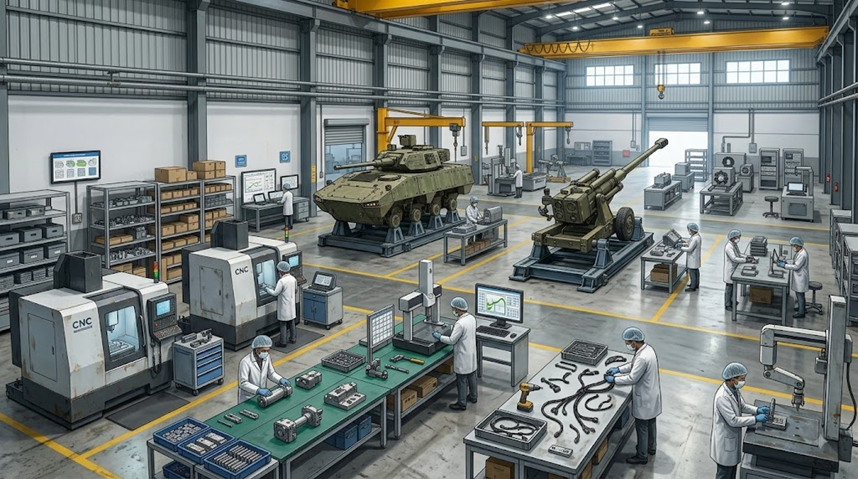
Export readiness rests on the industrial system behind the product: precision manufacturing, subsystem integration, testing, traceability and repeatable delivery.
The Signal
For much of India’s defence-industrial policy, the central objective was straightforward: reduce dependence on imports and increase indigenous production. That objective remains important, but the latest production and export data point toward a second phase.
Defence production reached a record ₹1.78 lakh crore in FY2025–26, while exports reached ₹38,424 crore. India is now exporting defence products to more than 80 countries through an exporter base of 145 firms. Private companies contributed roughly 24% of total defence production, but accounted for about 45.16% of defence exports.
That divergence is strategically interesting. A defence industry built principally around domestic procurement can scale through national demand. An export-capable defence industry has to clear an additional set of hurdles: price, qualification, delivery discipline, customer-specific configuration, interoperability, lifecycle support and long-term confidence from foreign armed forces.
The Numbers
Four figures define the shift: ₹1.78 lakh crore of defence production in FY2025–26; ₹38,424 crore of defence exports in the same year; export reach across more than 80 countries; and 145 firms participating in the export ecosystem. The government has also set a defence-export target of ₹50,000 crore by 2029.
The more revealing structural comparison is between production and exports. Public-sector enterprises and DPSUs still account for roughly 76% of total defence production, leaving private industry at about 24%. In exports, however, the private-sector share rises to approximately 45.16%. That suggests exports may become an important scale channel for private-sector defence manufacturing.
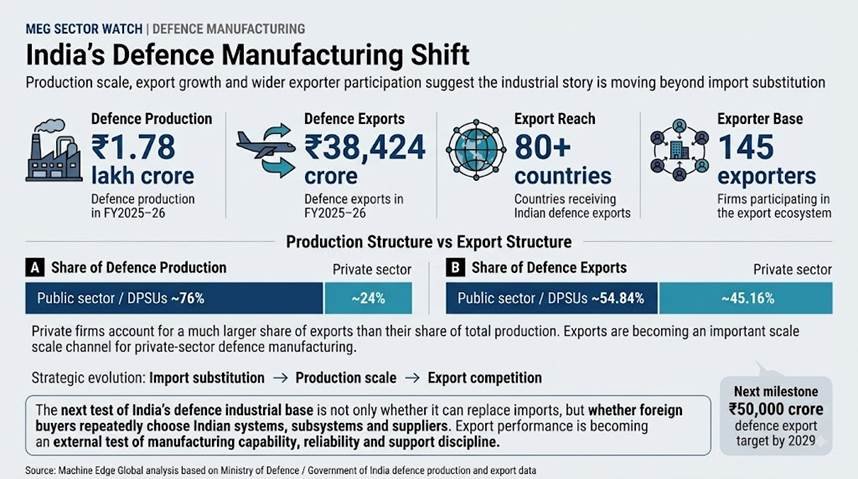
Visual 1 | Production scale is rising, but the export structure reveals an additional signal: private firms carry a much larger share of exports than of total production.
Export Scale Requires a Different Manufacturing Discipline
Winning a domestic defence order and competing internationally are related, but they are not identical industrial tests. Export customers introduce additional requirements that force the manufacturing system to operate across more varied environments and support expectations.
Configuration discipline becomes more demanding because customers may require different communications systems, sensors, weapons interfaces or environmental adaptations. Qualification has to move beyond national trials to customer-specific acceptance. Delivery schedules and spare-parts availability become part of competitive credibility. Interoperability matters because exported systems must fit into external communications, logistics and weapons architectures. And lifecycle support expands into training, documentation, upgrades, overseas maintenance and field service.
These requirements turn export performance into a manufacturing-system capability rather than simply a sales achievement. A product can win an order once; sustaining foreign fleets and earning repeat orders requires repeatable industrial discipline.
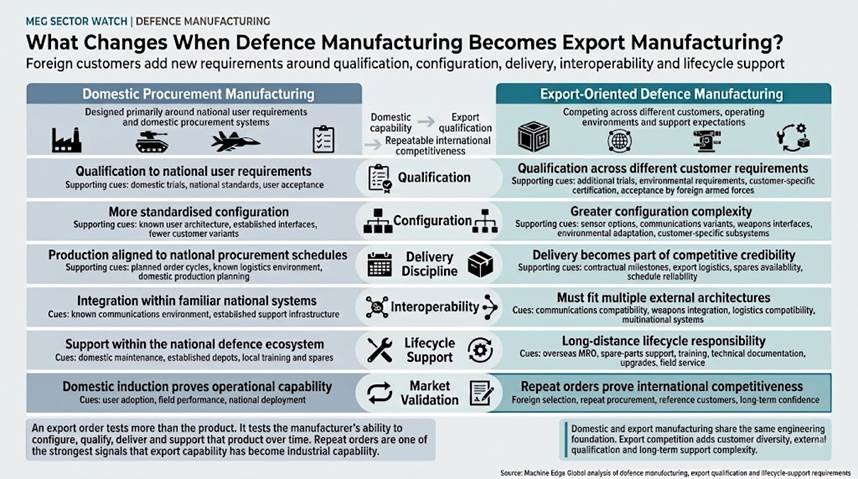
Visual 2 | Export manufacturing adds external qualification, configuration complexity, delivery discipline, interoperability and long-distance lifecycle responsibility.
The Industrial Opportunity
The export opportunity extends well beyond complete platforms. Defence value chains contain multiple layers: complete systems such as aircraft, naval platforms, armoured vehicles, artillery, missiles and drones; subsystems such as radars, electro-optics, electronic warfare, propulsion, communications and fire control; components such as actuators, valves, connectors, power electronics, precision-machined parts and composites; consumables and munitions; and lifecycle services including maintenance, overhaul, upgrades, training and spares.
That means export growth does not require every manufacturer to become a platform OEM. A supplier capable of meeting defence quality, traceability and delivery requirements can enter international programmes through components and subsystems as well. India’s defence ecosystem now includes 16 DPSUs, around 500 licensed defence companies and nearly 17,000 MSMEs, creating a wide base from which export-oriented supply relationships can potentially deepen.
The Private-Sector Signal
The production/export split deserves continued attention. Public-sector enterprises remain the dominant production base, and their own exports have risen sharply. But private companies account for a disproportionately large share of export value relative to their domestic production share.
That does not imply the private sector is replacing DPSUs. It suggests something more useful: exports may become one of the channels through which private-sector defence manufacturing develops volume, qualification experience and international customer relationships faster than its share of domestic production might imply.
From “Made Here” to “Chosen Elsewhere”
Import substitution answers one strategic question: can India manufacture the equipment it needs? Export success answers another: will somebody else choose it when they have alternatives?
Foreign buyers compare acquisition cost, performance, reliability, delivery schedules, financing, political risk, supply security and lifecycle support. That pressure introduces external market discipline into the industrial base. Export growth can therefore become more than an additional revenue stream; it can become an external test of the maturity of India’s defence-manufacturing system.
What MEG Is Watching
| Exporter breadth Whether the current base of 145 exporters broadens beyond a limited set of major firms. | Repeat orders The strongest signal that international acceptance is becoming durable rather than transactional. |
| Subsystem exports Whether Indian suppliers become embedded in global defence value chains, not only complete-platform sales. | Lifecycle support Whether overseas fleets create durable MRO, training, upgrades and spare-parts businesses for Indian manufacturers. |
India has already moved substantially from being only a defence buyer toward becoming a defence builder. The next test is whether other countries choose Indian systems, subsystems and suppliers—and keep buying them.
Sources & Further Reading
• Press Information Bureau / Ministry of Defence — defence exports, exporter base and country reach
• Department of Defence Production — defence manufacturing and indigenisation ecosystem
Editorial note: Figures reflect publicly reported Government of India data for FY2025–26. Export orders, commissioning schedules and sector shares may evolve as new contracts and production data are reported.